Same leak, second time around
A Volvo rolled into our Welshpool workshop the other day with a familiar complaint — oil dripping from the front of the engine. Nothing unusual about that on its own. What was unusual was that the customer had just paid another workshop to replace the front crank seal. New seal. Same leak.
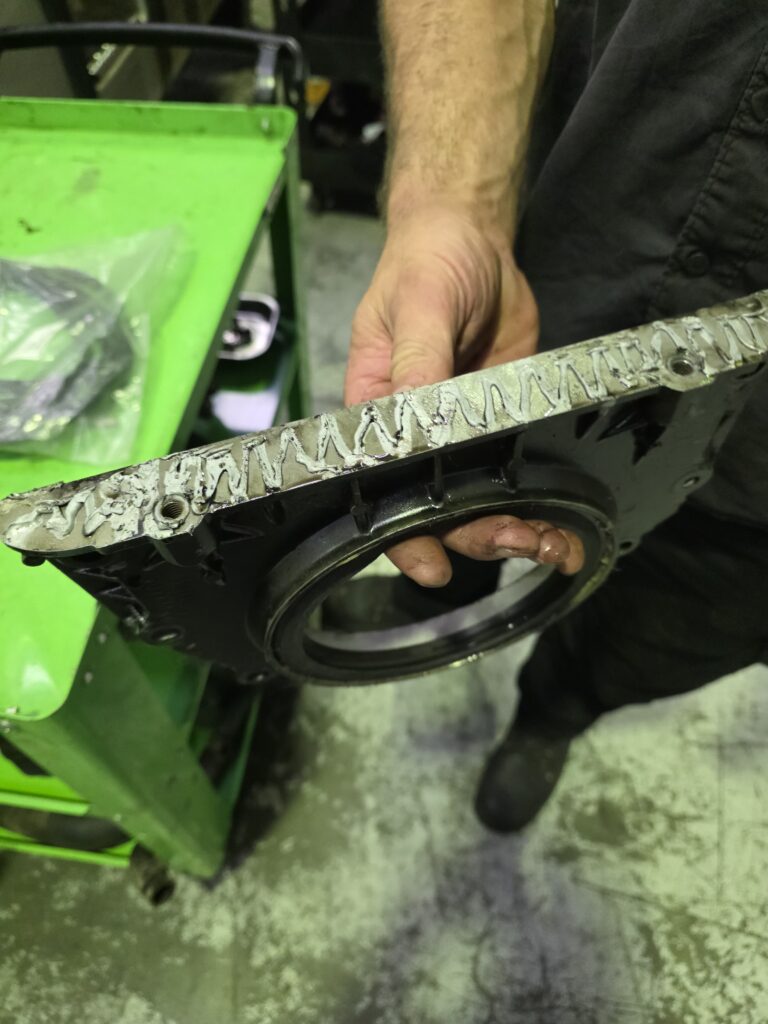
When we pulled the front cover off, the seal itself was fine. The silicone work, on the other hand, told the whole story.
Why it matters
Most people assume gasket silicone is one of those bits of the trade where you can’t really go wrong. Squeeze it on, bolt it up, job done. It’s not. The way silicone is applied is the difference between a seal that holds for the life of the truck and a seal that’s already weeping the day the cover goes back on.
For an owner-driver, that’s the difference between paying once and paying twice. The part is cheap; the labour is the expensive bit, and front-end work on a heavy diesel isn’t a small job to redo.
How not to do it
Here’s what we found on the Volvo. The previous workshop had laid silicone down in the bead shape it comes out of the tube — a fat, lumpy, uneven line — and then bolted the cover straight on top of it. That’s the part that goes wrong.
When silicone is left as a thick bead, three things go against you. One — there’s no flat sealing surface. When you clamp the cover down, the silicone bunches up unevenly, leaving thin spots where the joint isn’t sealed at all. Two — a thick bead takes much longer to skin and cure. Looking at this job, the silicone had probably started skinning over before the cover even went back on, which means the surface didn’t fully bond to both sides. Three — when you tighten the bolts, all that extra material has to go somewhere. You get massive squeeze-out, both on the outside (the visible mess) and on the inside (where it can break off and find its way into places it really shouldn’t be).
Put those three together and you’ve got a sealing surface that’s bubbled, uneven, partially cured before it was clamped, and far too thick. Oil finds its way through every one of those weak spots. Which is exactly what happened.
How we do it
The right way isn’t fancy — it just takes another two minutes per joint. We lay a clean even bead of silicone right around the sealing face. Then, before we go anywhere near the cover, we smear that bead flat with a finger or a small tool. Not gone, just flat — one thin, smooth, continuous film across the whole face.
That flat smear does three things at once. It fills any tiny pores and micro-imperfections in the casting (which is what silicone is actually for — gaskets seal the big joint, silicone fills the small stuff). It eliminates the lumpy mass that would otherwise squeeze out in all directions. And it gives both sides of the joint a clean, even surface to grab when they’re brought together while the silicone is still wet.
Then the cover goes on, the bolts get torqued in the correct sequence — same logic as lubing head bolts — and the joint sets up properly with no leak path through it. Done once, done right.
The takeaway
Two workshops can put exactly the same part in your truck and walk away with two completely different results. The trade is in the bits that don’t have a part number — how the surface is prepared, how the silicone is laid down, how the cover is brought together, how the bolts are torqued.
If your truck has come back from a recent repair and the leak hasn’t gone away — or you’ve started seeing oil where there wasn’t oil before — drop us a line. Webbie’s Mechanical, Welshpool. Heavy diesel specialists. We’ll pull the cover, find the cause, and put it back together so it actually seals.