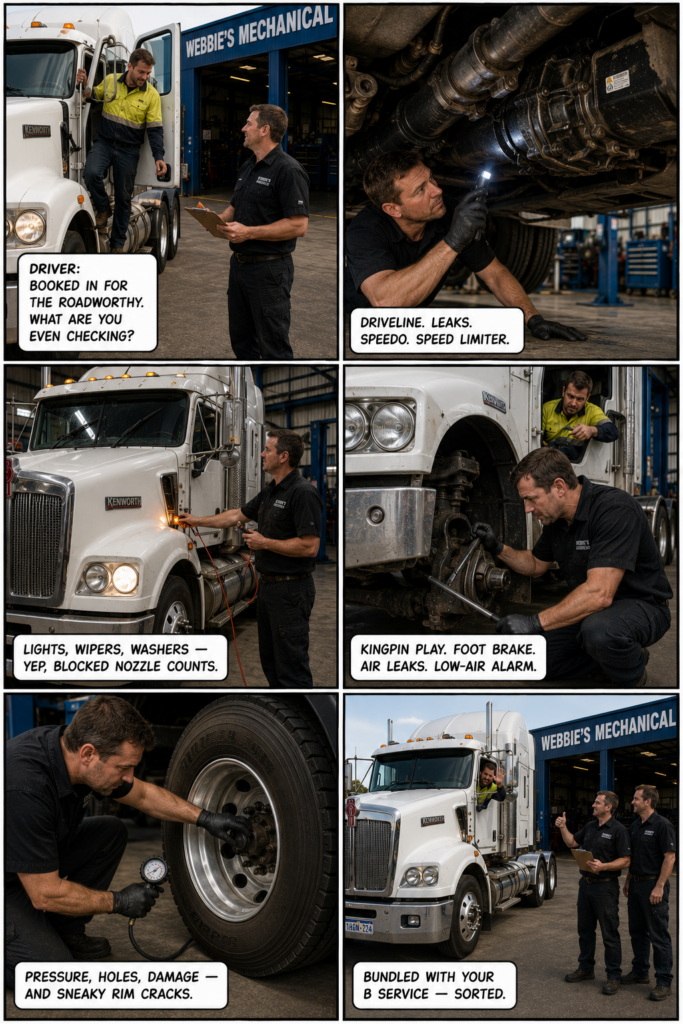
Ever wondered what a Roadworthy Accreditation check actually checks?
If you’ve ever had to organise a Main Roads Roadworthy Accreditation check, you’ve probably wondered what we’re actually looking at. Fair question — most of it happens under the truck, and “please sign here” doesn’t tell you much.
Here’s the inside view: the six categories on the checklist, what each one covers, and what’ll catch you out.
Why this matters
A Roadworthy is the inspection that decides whether your truck is road-legal or off the road. Worth knowing the list, because most of it is the kind of stuff you can keep an eye on between services and bring up at your next B service before it bites you.
The six categories — what’s on the list
Driveline. Engine, exhaust, transmission, speedo, speed limiter, vehicle performance, fuel and oil leaks. We’re checking for no exhaust leaks, no transmission leaks, no diff leaks. A wet seal is fine — the minute there’s a drop or active drip, that becomes a Roadworthy issue. Vehicle has to perform as it should: a truck down on power is technically a safety issue. Speedo accurate, speed limiter set to 100 on prime movers.
Electrical. Wiring, batteries, connectors, headlights, driving lights, parking lights, indicators, stop, tail and number lights, reflectors, horns, windscreen wipers. Blocked washer nozzle or a washer pump not pumping water? Roadworthy issue — we’ll unblock them. All reflectors going, all lights working.
Bodywork. Number plates and registration panels, mud flaps, white stripes, rear markers. Rust pressing the chassis rails apart on a prime mover is classed as unroadworthy. Pedal pads on the clutch, accelerator and brake. Mirrors and glass in good working order, no damage. All doors working, all locks working, up/down controls all there.
Chassis and suspension. Damage, corrosion, rust, suspension and shock absorbers, turntables, kingpins. We always check kingpins for up/down play and in/out play. We check shock absorbers — if they’re weeping, that’s a sign they’re on their way out. Rubbers checked for play. Body damage assessed. Plus steering — ball joints and wheel bearings, all good.
Brakes. Brake lines, hoses, brake fluid (if that’s the system you have), foot brake working, park brake working, brake light coming on with the pedal. Air leaks on the foot brake — technically a failure. We also let the air down to make sure the low-air alarm buzzer comes back on.
Tyres and rims. Right pressure, no holes, no damage to the tyres, no cracks in the rims. A sneaky rim crack will cost you — we look for them.
Related reading: Why Do We Punch a Hole in the Oil Filter? · How to Check for Play in Turntable Bushes · Services · Inside the Workshop
Time it with your B service
Majority of what’s on the Roadworthy list gets covered in a B service anyway. Bundling them is the obvious move — saves labour and gets two jobs done in one stop. We’ll usually book them together if your truck is due, so you’re not pulling the truck off the road twice.
Takeaway
Knowing what’s on the list takes the surprise out of the inspection. If you’ve got a Roadworthy coming up — or you’ve never had one done and want to start — book it in, ideally with your B service, and we’ll have it sorted.