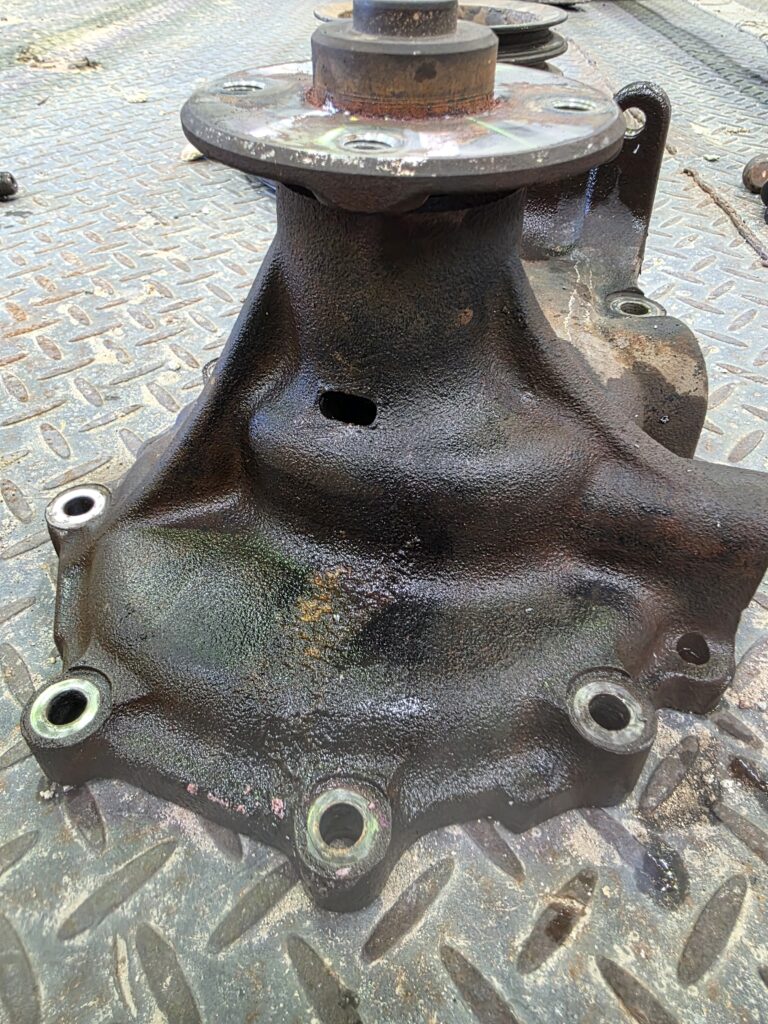
The little part doing the biggest job
Most drivers never give it a thought. The water pump sits up the front of your engine, quietly spinning. You only think about it the day it stops — and by then, it’s already too late.
A water pump’s job is dead simple. Keep coolant moving through the engine. Stop the flow, and the heat that’s being generated inside your block has nowhere to go. The truck cooks. Fast.
Why it matters
Here’s the bit that catches owner-drivers out. A water pump is a relatively cheap part. The damage it can do when it fails — that’s anything but cheap.
A failed pump on the highway means coolant stops moving. Engine temp climbs. Head gasket lets go. Heads warp. In a worst case, you’re staring at a full engine rebuild because a $400 part decided to give up on a hot afternoon between Perth and Karratha. Catch it early, and you swap one component. Miss it, and the bill multiplies.
How a water pump actually works
Inside every water pump is a little fan-shaped piece called an impeller. It looks like a tiny propeller. The pump is driven off the engine — usually by the fan belt — so the moment the engine starts turning, the impeller starts spinning.
That spinning impeller pushes coolant out of the pump and into the engine. The coolant runs around the cylinders, picks up the heat, then carries on to the radiator where the heat gets dumped out into the air. Then it loops back to the pump and starts again. Simple, constant, and absolutely critical.
Take the pump out of that loop — bearing seizes, impeller breaks, seal lets go — and the loop stops. From the moment the flow stops, you’ve got minutes before the temperature starts climbing into damage territory.
Four warning signs to spot early
The good news is that a water pump rarely fails without telling you first. Here’s what to look for.
Overheating. The first symptom — and the loudest. If your temp gauge has started creeping up where it didn’t used to, take notice.
Coolant drips. Every water pump has a small hole on the underside called the tell-tale hole. It’s there for a reason — when the internal seal starts to fail, coolant weeps out of that hole before it makes its way into anywhere it shouldn’t. If you’ve got drips coming from the front of the engine onto the floor, that’s the pump talking to you.
Noisy bearing. The pump bearing is what lets the impeller spin freely. When it starts to wear out, you’ll hear a whine or a low rumble from the front of the engine, usually getting worse as the engine warms up.
A belt that’s turning shiny. If the pump’s bearing is dragging, the belt can start slipping over the pulley. Look at the belt — if the edges are curling up and the running surface is glossy instead of matte, the belt is being asked to do more than it should.
If you spot one — book it in
Any one of those signs is enough to act on. Two of them, and you should be heading for the workshop now, not later. A small puddle of coolant on the floor where there wasn’t one yesterday is not a maintenance item — it’s a warning shot.
In the workshop we’ll pressure-test the cooling system, pop the belt off, spin the pump by hand, and check for play in the bearing. If it’s done, the pump comes off, a new one goes on, the system gets refilled and bled, and the truck goes back out cool and quiet. Inside the workshop, it’s typically a half-day job. Out on the road, with a cooked engine, it’s a recovery and a rebuild.
The takeaway
Your water pump is the cheap insurance policy on the most expensive part of your truck. The signs are easy to spot if you’re looking — drips under the front, a noise that wasn’t there before, a temp gauge that’s started misbehaving.
Catch it early, save yourself a major breakdown. Drop us a line — Webbie’s Mechanical, Welshpool. Heavy diesel specialists, and we’d much rather see your truck on the bench for a pump swap than on the back of a tilt tray.