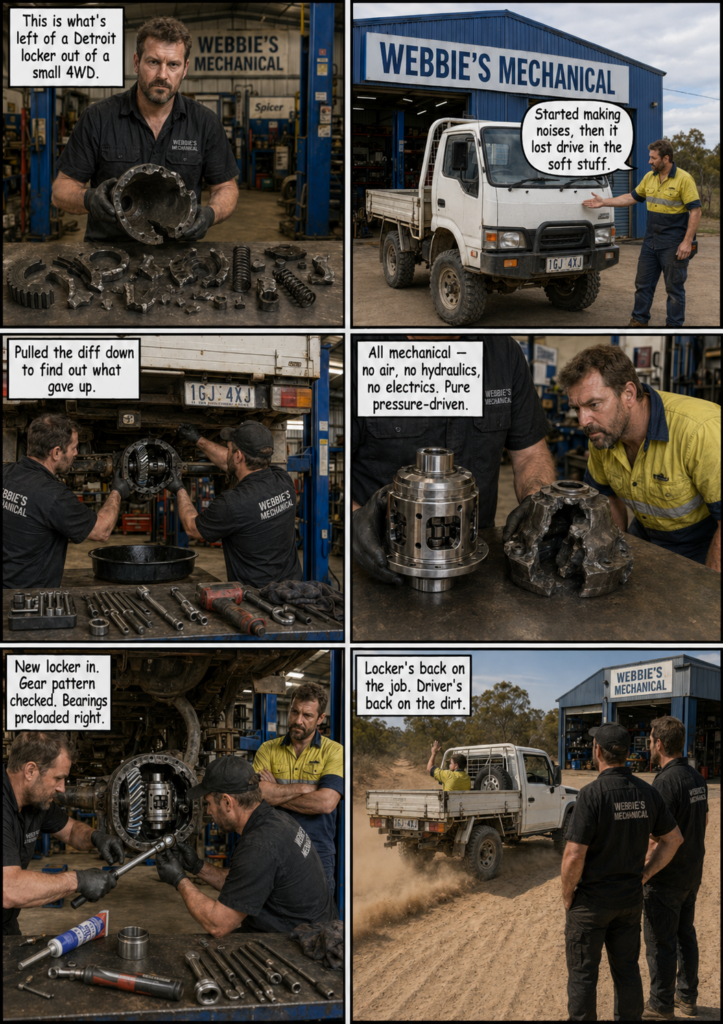
What’s left of it
Sitting on the bench is what used to be a Detroit locker — out of a small four-wheel-drive truck. Springs popped. Bits scattered. Not pretty, but it’s a good excuse to talk about what these things actually do.
Most drivers know they’ve got a locker in the diff. Plenty of them have never had one fail until they have one fail. So before this one heads to the bin, it’s worth showing what it was up to before it gave up.
Why it matters
Your locker is doing a clever mechanical job every single kilometre. When you’re going straight through soft sand, it keeps both rear wheels driving together so you don’t bog. When you swing into a corner on hard ground, it lets the inside wheel slip so you can actually turn. Get all that right with no driver input, and you barely notice it.
Get it wrong — or have it fail — and you’ve got a noisy diff, chewed-up tyres, and a 4WD that either won’t drive straight or won’t turn properly. For the work that little 4WDs get put through, that’s not a small problem. We see this kind of failure regularly in the workshop, usually after the locker’s been making noises for a while and the driver’s hoped it would settle.
How a Detroit locker actually works
Here’s the part most people don’t know. A Detroit locker isn’t air, it isn’t hydraulic, and it isn’t electric. There’s no button on the dash. There’s no compressor pumping it on. It’s purely mechanical, and it lives right in the centre of the diff.
Inside the locker are springs sitting either side of the centre, and those springs feel the pressure coming through each axle. The locker reads that pressure to decide what to do.
If the pressure on both rear wheels is even — like when you’re driving straight through soft sand — the locker stays engaged and both wheels drive together. The moment the pressure on one side changes — like when the inside wheel needs to spin slower around a hard corner — the locker senses the shift and releases that wheel. Spring-loaded, pressure-driven, no driver input. It’s all happening inside the diff while you’re driving.
What we do with one like this
Once a locker fails, it’s not a part you patch. The whole unit comes out, the diff gets a full check — gears, bearings, housing — and a new locker goes in. Setting up a diff properly is one of those jobs where torque specs, gear pattern, and preload all have to be right or it’ll be back on the bench in a hurry. In the workshop, we set every diff up the same way: pulled down clean, new components torqued to spec, gear pattern checked under paste, then a road test before it goes home.
The takeaway
If your truck is making new noises through the diff, hopping in tight turns, or losing drive in soft ground — get it looked at before it ends up like this one. Drop us a line and we’ll have a look, set it up properly, and send you back out with a diff that does its job — locked when you need it locked, free when you need to turn.