You get a repair done and expect the problem to be over.
That’s the whole point, right?
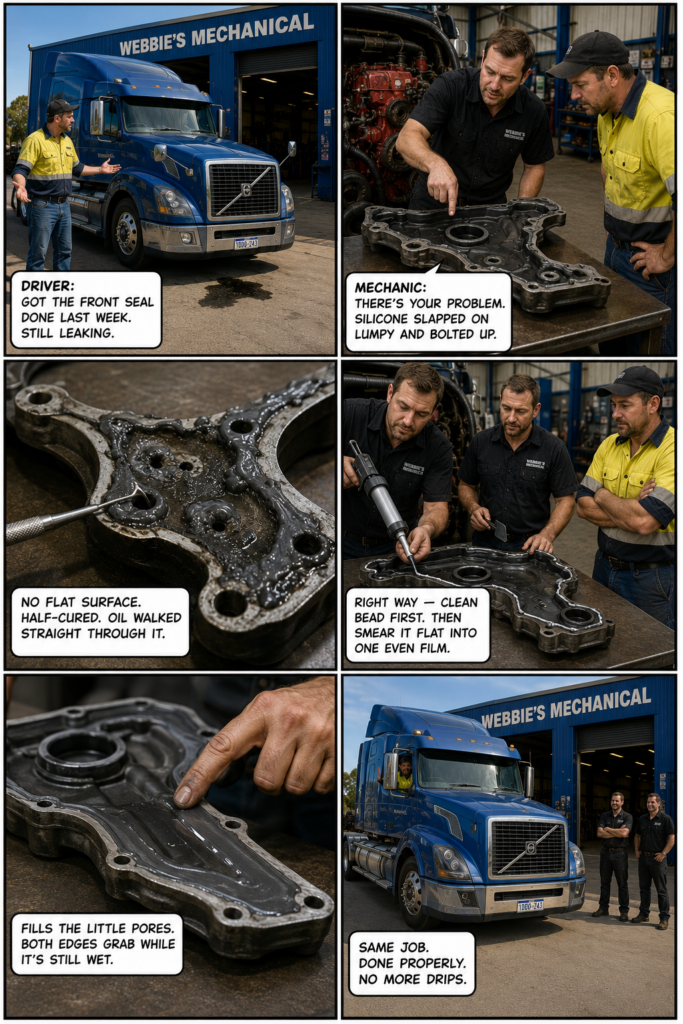
So when this blue Volvo rolled into the workshop with fresh oil underneath it, the driver was understandably frustrated.
“Got the front seal done last week,” he said.
“Still leaking.”
Not exactly what you want to see after paying for a repair.
The truck itself looked tidy. No major mess underneath. Just a steady dark patch forming under the front of the engine every time it sat still.
Enough to know something wasn’t right.
Enough to know it wasn’t fixed.
So we got it inside and started pulling it apart.
Once the front timing cover came off, the problem revealed itself pretty quickly.
The sealing surface was covered in thick, uneven silicone.
Big lumps. Air bubbles. Half-cured sections squeezed out everywhere.
It looked like the silicone had been applied heavily and bolted straight together before it had seated properly.
And that’s the thing with sealing surfaces — more silicone doesn’t mean better sealing.
In fact, too much usually causes problems.
Because when the surface isn’t even, oil finds a path.
And oil is incredibly good at finding the smallest imperfections.
In this case, it had worked its way straight through the uneven silicone and continued leaking almost immediately after the repair.
Not because the front seal itself was necessarily wrong.
But because the preparation and sealing process wasn’t done properly.
So we cleaned everything back properly.
Every old trace removed.
Every sealing face cleaned and checked.
Then we started again.
Fresh silicone laid down in a clean, even bead.
Not rushed.
Not overloaded.
Then instead of simply bolting it together, we carefully smeared the bead into one smooth, even film across the entire sealing face.
That step matters more than people realise.
It fills the tiny pores and imperfections in the metal surface and allows both mating faces to grab evenly while the silicone is still wet.
No gaps.
No bubbles.
No thick blobs waiting to squeeze out internally.
Just one clean sealing surface done properly from the start.
Then everything went back together.
Torqued correctly.
Checked properly.
Cleaned down completely.
And finally — the real test.
We let it idle.
No drips.
Ran it longer.
Still dry.
Then a road test.
Back into the workshop… still clean underneath.
That’s when you know the repair’s right.
Sometimes the difference between a truck that keeps leaking and one that stays dry isn’t the part itself.
It’s the preparation.
It’s the care.
It’s taking the extra time to do the small details properly instead of rushing to bolt it back together.
Because “good enough” usually comes back.
Done properly usually doesn’t.
📍 Webbie’s Mechanical | Welshpool
📞 (08) 9353 1289
Same job. Done properly this time.